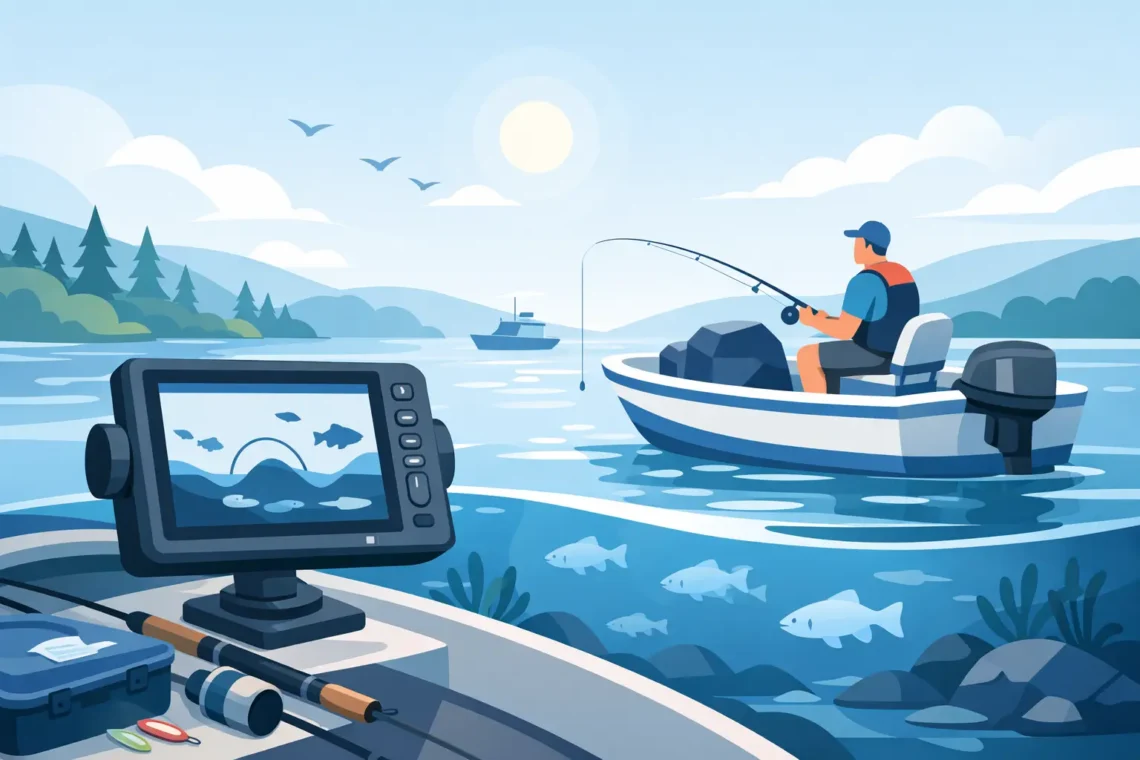
A small boat changes what matters in a sonar unit fast. Screen size, power draw, mounting space, and ease of use all matter more when you are working from a jon boat, skiff, aluminum utility boat, or compact fishing rig. If you are shopping for the best fish finder for small boat use, the right choice is usually not the biggest or most expensive model. It is the one that fits your space, your battery setup, and the kind of water you actually fish.
This guide is built for anglers who want a dependable shortlist instead of sorting through dozens of similar models. The picks below focus on practical value, straightforward performance, and feature sets that make sense on smaller boats.
7 best fish finder for small boat options
1. Garmin STRIKER Vivid 4cv
For many small-boat anglers, this is the easy starting point. The 4-inch display keeps the unit compact, while CHIRP sonar and ClearVü give you enough detail to read bottom contour, bait, and structure without demanding much dash space. It is especially well suited to jon boats and older aluminum rigs where mounting room is limited.
The main appeal is simplicity. Garmin keeps the interface clean, and the built-in GPS lets you mark spots and create basic routes without stepping up to a full chartplotter. The trade-off is screen size. On a calm day that is fine, but if you like to split views often, the small display can feel cramped.
2. Humminbird HELIX 5 CHIRP DI GPS G3
If you want a stronger balance of screen space and fish-finding performance, the HELIX 5 is one of the safest picks in this category. A 5-inch screen is a real upgrade on a small boat because it makes sonar returns easier to read at a glance, especially while moving or fishing in wind.
Down Imaging is useful for anglers targeting brush piles, laydowns, and transitions around docks or creek channels. The GPS features are also more serious than what you get on many entry-level units. The downside is that this unit asks for a little more mounting room and a little more budget, but for many buyers, the jump in usability is worth it.
3. Lowrance Hook Reveal 5 SplitShot
The Hook Reveal 5 SplitShot is a strong fit for anglers who want good sonar performance without a steep learning curve. Its FishReveal feature can help separate fish from structure more clearly, which is useful if you fish stained lakes, reservoirs, or mixed-bottom areas where standard sonar can feel busy.
On a small boat, the 5-inch size hits a sweet spot. It is still manageable on a compact console or bracket mount, but large enough to support split-screen views without becoming frustrating. The trade-off is that this model makes the most sense for inland anglers and casual coastal users rather than anyone looking for advanced networking or premium charting.
4. Garmin ECHOMAP UHD2 53cv
This is the upgrade pick for small-boat owners who want better mapping capability along with crisp sonar performance. Compared with simpler STRIKER units, the ECHOMAP line gives you more flexibility if navigation matters just as much as fish finding.
That can be a big deal on larger lakes or unfamiliar water where waypoint management and mapping become part of the day. The screen size still works on small boats, but this unit starts to make the most sense when you have a solid 12V setup and enough mounting space to use it comfortably. If you mostly fish local ponds or small reservoirs, it may be more unit than you need.
5. Humminbird PIRANHAMAX 4 DI
Budget shoppers should not ignore the PIRANHAMAX 4 DI. It is one of the better low-cost ways to get a usable screen and Down Imaging in a compact package. For occasional anglers, weekend panfish trips, or a basic second-boat setup, it covers the essentials without much fuss.
Its biggest advantage is value. Its biggest limitation is also obvious – this is a simpler unit with fewer advanced mapping and networking features. If your goal is just to read depth, identify bottom hardness, and get a clearer look at structure, it does the job well for the money.
6. Lowrance Eagle 4x
Some anglers want the lightest possible setup with minimal battery demand and a quick install. The Eagle 4x makes sense there. It is compact, straightforward, and easy to pair with a very small fishing platform where every inch matters.
This kind of unit is best for anglers who do not need built-in maps or advanced navigation tools. You are choosing it for sonar basics, easy setup, and low cost. That makes it a strong fit for small utility boats, portable transducer setups, or anyone trying to keep electronics simple.
7. Garmin STRIKER Vivid 5cv
If the STRIKER Vivid 4cv feels a little too small but you still want a user-friendly Garmin unit, the 5cv is the better middle ground. It offers more viewing comfort without pushing into the larger footprint and higher pricing of more advanced chartplotters.
For many recreational anglers, this is where value peaks. You get clear sonar, GPS waypoint marking, and a screen that is much easier to read while standing or moving around a compact deck. The trade-off is that it still is not a full mapping-first unit, so buyers who prioritize navigation may want the ECHOMAP instead.
How to choose the best fish finder for small boat use
The first thing to get right is size. On a small boat, even a good fish finder becomes annoying if it crowds the console, blocks access to switches, or is hard to see from your casting position. In most cases, a 4-inch or 5-inch unit is the smartest choice. Larger screens can be excellent, but only if your layout supports them.
Power draw matters more than many buyers expect. A compact boat often runs a smaller battery setup, and that affects how comfortably you can power electronics for a full day. If you fish short trips on electric-only lakes or rely on a modest battery box, a simpler unit with lower power demand can be the smarter buy than a feature-packed model you rarely use.
Sonar type should match your water. Basic CHIRP sonar is enough for plenty of anglers who mainly want depth, fish arches, and general bottom reading. Down Imaging or ClearVü becomes more useful when you spend time around timber, brush, rock piles, docks, or ledges. Side imaging can be great, but on a truly small boat it is often a luxury rather than a must-have because it adds cost and complexity quickly.
GPS is another feature worth thinking through honestly. If you return to brush piles, offshore humps, or specific channel edges, waypoint marking is very helpful. If you mostly fish visible shoreline cover or small local water, you may not need advanced mapping at all.
What actually matters more than brand
Garmin, Humminbird, and Lowrance all make dependable options in this category. The better question is not which brand is best overall, but which unit fits the way you fish. A clean interface matters more for beginners than a long feature list. A readable screen matters more than one extra sonar mode you may never touch.
Mounting and transducer placement also affect real-world performance more than shoppers sometimes realize. A midrange unit with a clean transducer install will often outperform a more expensive model that is mounted poorly or loses bottom at speed. On small aluminum boats especially, setup quality can make or break your experience.
Best picks by buyer type
If you want the best all-around value, the Garmin STRIKER Vivid 5cv is hard to beat. If you want the best budget choice, look at the Humminbird PIRANHAMAX 4 DI. If mapping and navigation matter most, the Garmin ECHOMAP UHD2 53cv stands out. If you want a balanced 5-inch unit with strong imaging, the Humminbird HELIX 5 CHIRP DI GPS G3 and Lowrance Hook Reveal 5 SplitShot both deserve a close look.
For very small boats with limited space, the Garmin STRIKER Vivid 4cv and Lowrance Eagle 4x make the most sense. They keep things compact while still delivering the kind of sonar performance that helps you fish more efficiently.
At Outdoor Patron, we usually tell buyers to be honest about where they fish most, not where they hope to fish once or twice a year. That one decision tends to narrow the field faster than any feature chart.
A good fish finder on a small boat should feel like a helpful tool, not another thing to manage. Pick the model that fits your boat cleanly, gives you the sonar detail you will actually use, and keeps your day on the water simple.